For simply noticing a signal, hearing and touch are nearly tied at around 150 milliseconds — both beat vision. But a pointing device doesn't ask you to notice. It asks you to move: adjust pressure on the ball, stop the ring on the right line, ease off in precision mode. That's closed-loop motor control, and there touch wins clearly.
Audio feedback has to be decoded — pitch, pattern, volume — into a spatial command before your hand can act. Touch skips the step: tactile signals share pathways with proprioception, your body's own sense of where the hand is.
Direct pressure can trigger low-level stretch reflexes. Muscle adjustments start before conscious processing is finished.
In continuous control — steering a cursor, scrubbing a timeline, easing grip — that lead shows up as less over-steer and smoother movement. It compounds hundreds of times an hour.
Reaction-time figures are from motor-control literature (see sources), not O.R.B. bench measurements.
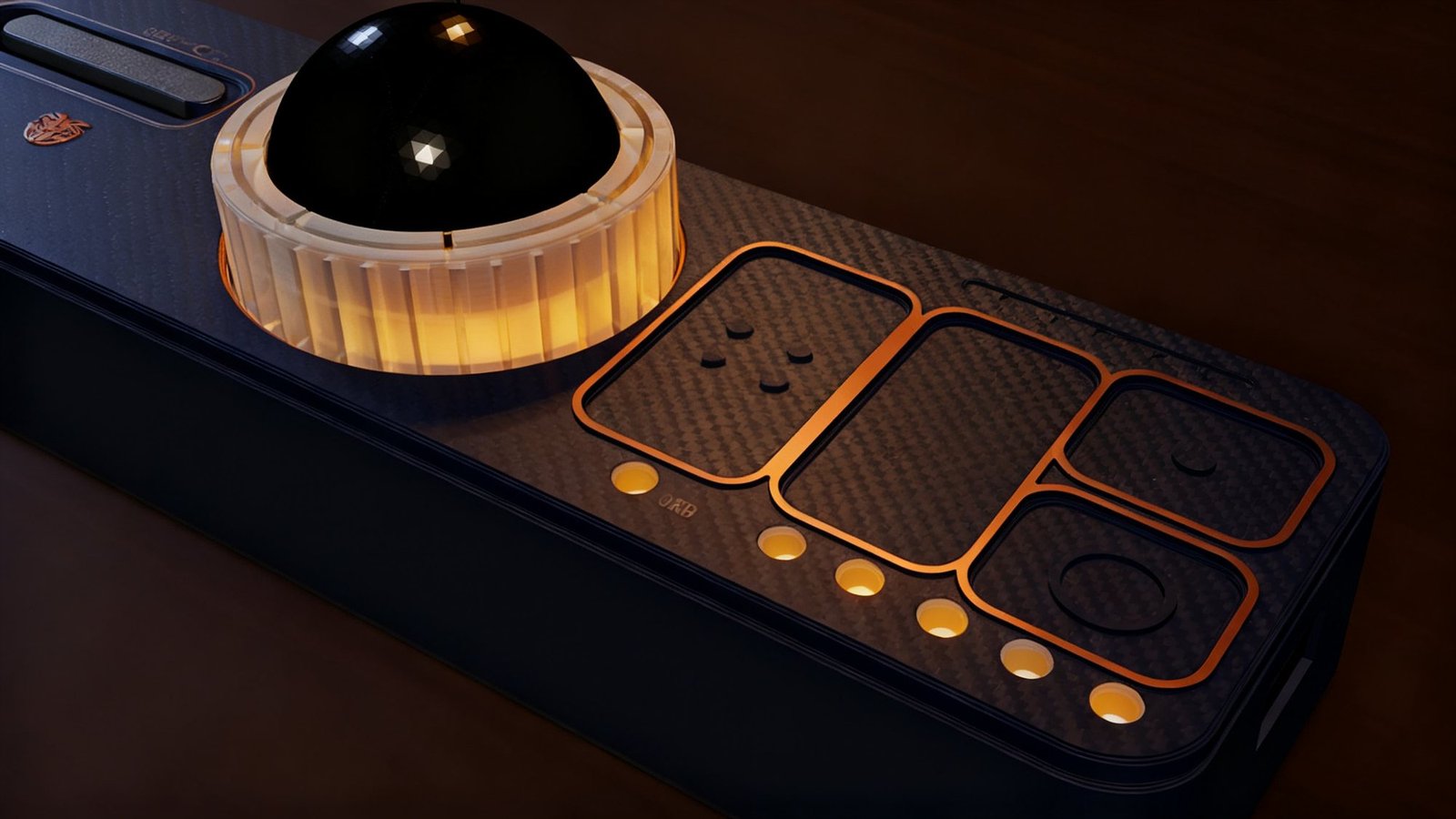
Each of the eight controls has its own haptic signature: sharp for click, soft for back, a double tap for push-to-talk, a small tick for every step of the ring. In the O.R.B. 2 the two actuators are bonded to the underside of the face plate you touch, one under the click cluster and one under the navigation pads, so the answer comes back under the finger that asked instead of somewhere in the body. Because touch shares pathways with your own sense of where your hand is, the map stops being something you remember and becomes something you know. Eyes up, hands on: the bar becomes an extension of the hand that runs it — a bridge between your reflexes and the machine, which is what the name means.
The bar makes no sound at all. Fourteen amber points do the talking the haptics cannot, counting your machines and asking the questions in the Handshake, and the loop stays in your hand. That loop is where the firmware is headed: feedback that tunes itself to how you move, so the fit gets tighter the longer you use it.
The most common way a pointing device dies is a worn switch — spring fatigue, oxidised contacts, the double-click that arrives a year or two in. O.R.B.'s controls are capacitive fields under two millimetres of solid composite, with no spring, no contact and no seam to wear.
| Mechanical switch | O.R.B. capacitive layer | Difference | |
|---|---|---|---|
| Rated actuations | 5–50 million clicks | 100 million – 1 billion+ touches | 5–20× |
| Mean time between failures | 50–100 k hours | 200–500 k+ hours | 4–5× |
| Failure mechanism | Spring fatigue, contact oxidation | Electronics aging — no physical wear | solid-state |
| Debris | Dust and hair get in | Sealed under the solid face | immune |
| Expected lifespan, heavy use | 2–5 years | 10–20+ years | 3–5× |
Component-literature figures for capacitive sensing vs. high-grade mechanical microswitches. Calculated estimates, not O.R.B. bench measurements.
The whole "silent mouse" category is a switch made quieter. Every trackball on sale, including the open-source ones, is built on mechanical switches and a mechanical scroll. O.R.B. is the only one with neither.
| Device | Controls | Scroll | Link | Price |
|---|---|---|---|---|
| O.R.B. 2 | 6 touch zones + slider · zero switches | contactless magnetic ring, 24 steps a turn, the ring is the halo | Bluetooth ×5 + USB-C | $49 files · custom-built runs |
| Logitech MX Ergo S | 8 mechanical switches | mechanical thumb wheel | BT + dongle | $100 |
| Kensington Expert Mouse | 4 mechanical switches | mechanical scroll ring | wired USB | $90 |
| Kensington SlimBlade Pro | 4 mechanical switches | twist the ball | tri-mode | $100 |
| Ploopy Adept | 6 mechanical switches | firmware drag-scroll | wired only | $75 |
| Contour RollerMouse Red | mechanical switches + rollerbar | mechanical wheel | wired | $374 |
Public list prices, August 2026.
The only trackball with no mechanical switch or encoder anywhere in it.
The only wireless device in the class with an independent, continuous scroll ring.
Centred pointing at numpad scale — the ergonomic answer to shoulder travel, in a bar that fits a jacket pocket and clicks to the angle you want.
The only one you can print from the production geometry and take apart in your browser before you buy.
Build it from the production files, or have one built for you.
Sources: simple reaction time by modality (Harvard); sensorimotor feedback latency (Frontiers in Neuroscience); microswitch and capacitive-sensor component ratings (manufacturer datasheets). Retrieved August 2026.